
There are any number of definitions of artificial Intelligence (AI), which over time are sure to evolve.
For example:
- International Organization for Standardization (ISO) – At its core, AI refers to computer systems capable of performing tasks that typically require human intelligence, such as reasoning, learning, perception and language understanding.
- International Business Machines Corporation (IBM) – Artificial intelligence is technology that enables computers and machines to simulate human learning, comprehension, problem solving, decision making, creativity and autonomy.
- National Institute of Standards and Technology (NIST) – A machine-based system that can, for a given set of human-defined objectives, make predictions, recommendations, or decisions influencing real or virtual environments.
That being said, the precise definition of AI used is to some degree irrelevant for this discussion.
Although oftentimes thought of as interchangeable, answers, understanding and learning are very different.
- An answer, is something spoken or written in reply to a question. An answer is generally binary, i.e., right or wrong.
- Understanding is a cognitive process. It can be defined as: “The acquisition, organization, and appropriate use of knowledge to produce a response directed towards a goal, when that action is taken with awareness of its perceived purpose.” (Hough A. R., Gluck K. A. (2019)).
- Learning is also a cognitive process. As defined by the American Psychological Association (APA): “Learning is the acquisition of new information, behaviors, or abilities after practice, observation, or other experiences, as evidenced by change in behavior, knowledge, or brain function. Learning involves attending to relevant aspects of incoming information, organizing the information into a coherent cognitive representation, and integrating it with relevant existing knowledge from long-term memory.”
As such, an answer is not the same as either knowledge or learning. The challenge that this presents is AI can get you to the “right” answer without either knowledge or understanding.
Consider that recently:
- Princeton instituted proctoring for in-house examination, reversing 130 (+) years of relying on the honor code due to perception on the part of faculty and students that cheating was both more widespread and harder to spot because of AI.
- Harvard put a cap on the number of A’s that can be awarded in a course.
- UC Berkley’s Center for Studies in Higher Education published a study that examined the impact of AI on grade inflation.
- As of early June 2026, over 1,400 University of California (UC) faculty across the University’s campuses have signed on to a letter asking UC leadership to require undergraduate STEM applicants, starting with the 2027-28 admissions cycle, to submit an SAT or ACT math score. Of concern is that students’ grade-point averages and application essays no longer reliably assess whether they are prepared for university-level STEM coursework amid an era of grade inflation and artificial intelligence tools.
- Cornell released a study on the impact of AI on admission essays.
- Duke stopped scoring admission essays.
The intersection of AI, college admissions, grade inflation and academic cheating can be represented graphically as:
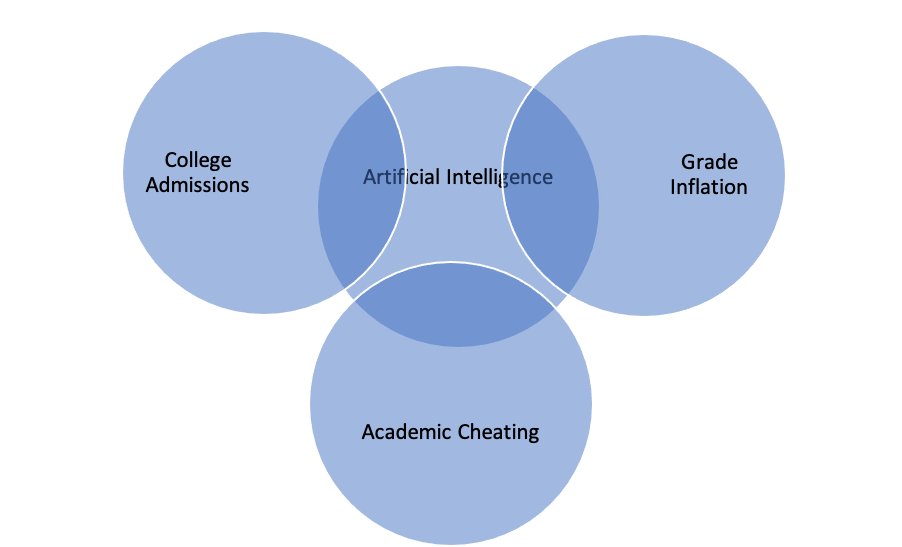
The relationship has profound implications for tertiary education and the workforce. If the goal of tertiary education is imparting learning and knowledge, two bedrocks of the workforce, AI’s influence on tertiary education cannot help but impact the future of work. If tertiary education, in whatever form, i.e., college, vocational or technical education, is the gateway to the workforce of the future, then it is critical that AI’s use, education and the workforce be aligned towards a common goal.